Table of contents
When you land in a new country and realize your best phrasebook line is “hello,” the trip can suddenly feel like a high-wire act. Yet in an era of translation apps, bilingual signage, and global English, millions of travelers still collide with language barriers every year, and not always in the ways they expect. In airports, cafés, rural bus depots, and last-minute medical visits, miscommunication can derail plans, but it can also open doors, forcing people to improvise, connect, and discover places beyond the obvious itinerary.
When words fail, instincts take over
Lost menus, missed stops, wrong turns; language gaps often hit hardest in the first 48 hours, when travelers are tired, overstimulated, and trying to decode everything at once. Tourism researchers have long noted that uncertainty is part of what makes travel emotionally intense, and language is a major driver of that feeling: you cannot predict outcomes, you cannot “scan” a conversation, and small decisions suddenly carry weight. In practice, that can mean overpaying for a taxi because you cannot negotiate, boarding the wrong regional train because the platform announcement is too fast, or nodding politely during a museum tour while understanding almost nothing. None of these moments are rare; they are the quiet, everyday friction of moving through a place where you do not speak the language.
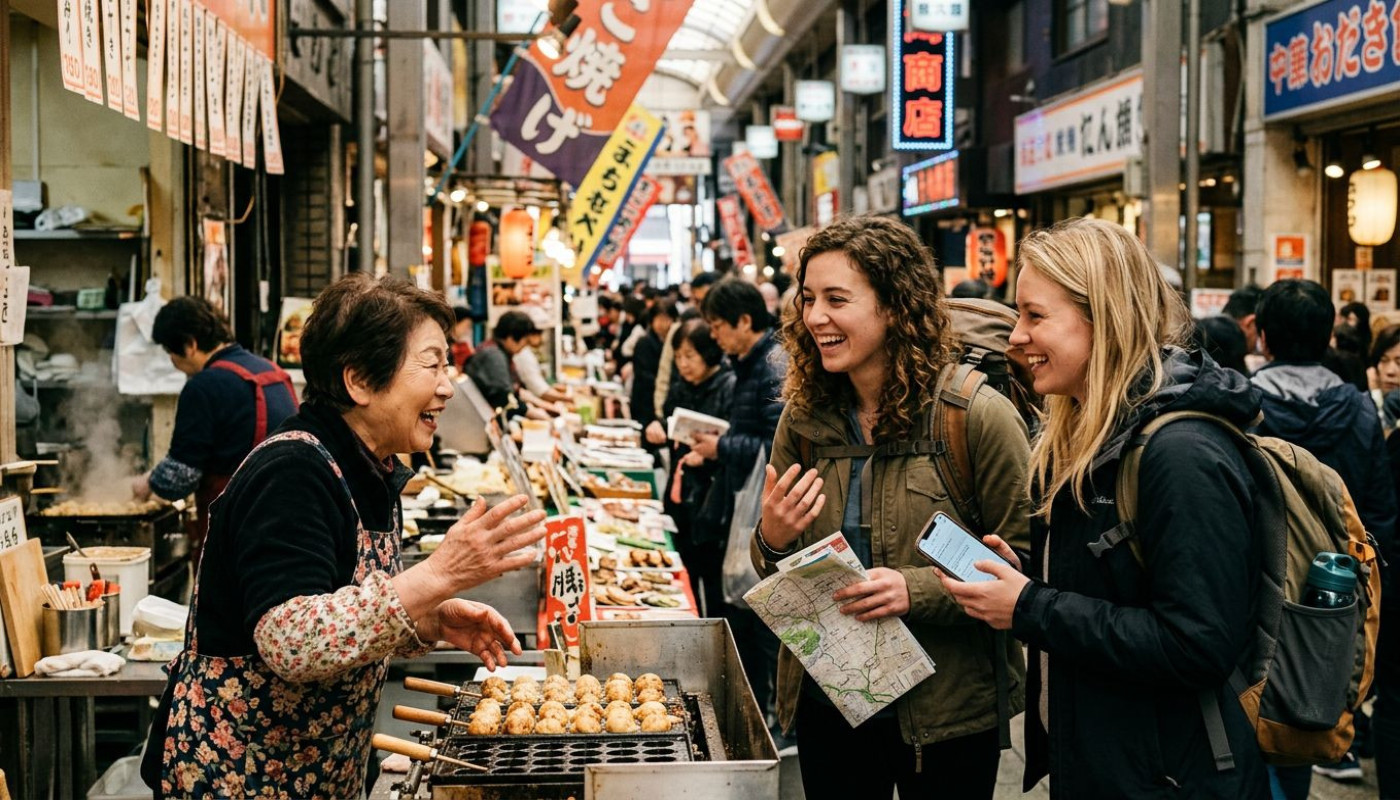
But the more interesting story is what happens next, because people adapt quickly when they have to. Gestures become a full vocabulary, drawings appear on napkins, and travelers start paying attention to nonverbal cues they would normally ignore: how a line forms, where locals stand to wait for the bus, how money changes hands at a market stall. Cognitive scientists sometimes describe this as “contextual inference,” the brain’s ability to fill gaps using environment and pattern, and travel is a crash course in it. Even a simple purchase becomes a small adventure, and that heightened awareness can pull you out of autopilot, pushing you to experience the street, the shop, the station as locals do rather than as a spectator insulated by fluent conversation.
The best encounters start with confusion
Who has not been rescued by a stranger with patient eyes and an improvised mix of words, hands, and laughter? The paradox of language barriers is that they can make human contact more likely, not less, because you are forced to ask for help. Studies on social interaction in unfamiliar environments consistently show that vulnerability increases approachability, and travel provides that vulnerability in a socially acceptable form: you are a visitor, you are expected to struggle, and people often respond to that reality with empathy. The result is that confusion becomes a social bridge, and a miscommunication can turn into an invitation, a detour, or a lesson you did not know you needed.
It is also why many seasoned travelers say their most memorable stories begin with a misunderstanding, not a perfectly planned day. You ask for a “quiet” neighborhood and end up at a lively local festival, you request a “simple” dish and receive the regional specialty that everyone eats on Sundays, you try to find a famous landmark and are guided instead to a viewpoint known only to residents. None of this is guaranteed, of course, and safety always matters, but the pattern repeats across destinations: when you cannot rely on language, you rely on people, and that reliance can produce the kind of travel that feels less like consumption and more like participation. It is a shift from “seeing” a place to being briefly woven into it, even if only through the shared comedy of getting it wrong.
Digital translation helps, but it changes travel
Technology has transformed the modern language barrier, and the numbers tell the story. The world now counts well over 7,000 living languages, according to widely cited linguistic catalogues, while international tourism has rebounded strongly since the pandemic shock, with global arrivals climbing back toward pre-2020 levels in many regions. Into that mix comes a powerful tool: instant translation, whether through camera-based menu translation, voice-to-text, or offline dictionaries. For many travelers, these tools reduce stress in high-stakes moments, such as communicating dietary restrictions, describing symptoms to a pharmacist, or clarifying a hotel check-in problem, and that practical benefit is hard to overstate.
Yet translation apps also reshape the travel experience in subtler ways. They can shorten conversations that might have unfolded slowly, they can turn an exchange into a transactional “input-output” process, and they can create a false sense of mastery. Anyone who has used machine translation for idioms knows the risk: a phrase can be technically translated and still socially wrong, because tone, humor, and cultural context do not map neatly. In some settings, pulling out a phone can also signal distance, as if the visitor is choosing a screen over the person in front of them. The more thoughtful approach is to treat technology as a safety net, not a substitute for effort, using it to avoid major errors while still attempting basic greetings, polite forms, and the kind of small talk that tells someone you see them as more than a service provider.
Québec shows how language shapes identity
If you want to understand why language barriers can feel so charged, you do not need to look far, because some destinations build their identity around language itself. Québec is a striking example: French is not only a means of communication, it is a cultural and political marker, protected by law and reinforced through education, signage rules, and public life. For visitors, that can produce a travel dynamic that is very different from places where English dominates the tourist economy. In Montréal, you might hear French, English, Arabic, Spanish, and more on the same block, while in smaller cities and rural areas the default can shift firmly toward French, and that shift changes how you navigate, how you ask, and how you listen.
For many travelers, that difference becomes the point rather than the obstacle, because it forces you to engage with local culture on its own terms. Ordering food becomes an exercise in pronunciation, reading a poster becomes a lesson in regional expressions, and a conversation becomes a reminder that language carries history. It is also a destination where “getting by” and “connecting” are not the same thing, and visitors often find that even a modest effort, a greeting, a courteous “please,” a willingness to try, earns warmth in return. If you are planning a trip and want a starting point for ideas, routes, and local perspective, https://www.quebec-spirit.com/ offers a useful window into the province, especially for travelers who want more than a checklist of attractions and are curious about the places where language, landscape, and everyday life intersect.
Plan smarter, stress less on arrival
Language barriers are most intimidating when they meet logistical pressure, so the practical fix is preparation that targets your first day. Save offline maps, screenshot your accommodation address in the local language, and keep a short list of essential phrases for transport, food, and emergencies. Many public services now provide multilingual support, but do not assume it will be available at the exact moment you need it, especially outside major hubs or late at night. A small notebook can still outperform your phone when the battery dies, and having key information written clearly can prevent a minor problem from snowballing into a ruined evening.
Budgeting also matters, because miscommunication often becomes expensive: the wrong ticket, the wrong date, the wrong size, the “yes” you did not mean. Build a modest buffer for small losses and treat it as part of the cost of travel, not a personal failure. When it comes to tours, classes, or guided experiences, booking ahead can reduce language stress, but leaving room for spontaneous choices can be just as valuable, precisely because language barriers tend to generate the most surprising detours. The goal is not to eliminate confusion, it is to keep it safe, manageable, and occasionally delightful, so you can let the barrier become what it sometimes is at its best: a spark for an adventure you could not have planned.
Your next steps before takeoff
Reserve early for peak weeks, and confirm cancellation terms; it is the simplest hedge against a misunderstanding. Set a realistic daily budget with a buffer for transport errors and last-minute changes. Check local and national programs that may offer travel discounts, museum free days, or regional passes, then print or download proof in the local language to avoid complications at the counter.
Similar articles

From Map To Memory: Why Activity Choices Define Your Journey
The Overlooked Travel Hacks Locals Never Share With Tourists

The Overlooked Role Of Microadventures In Modern Travel Trends

Beyond Souvenirs: Lasting Changes From Transformative Travel Experiences
